Denoising Diffusion Probabilistic Models(DDPM)
- Denoising Diffusion Probabilistic Models(DDPM)
- Paper Review
Denoising Diffusion Probabilistic Models(DDPM)
Paper Review
Denoising Diffusion Probabilistic Models (DDPM)
Denoising Diffusion Probabilistic Models
Diffusion model introduction
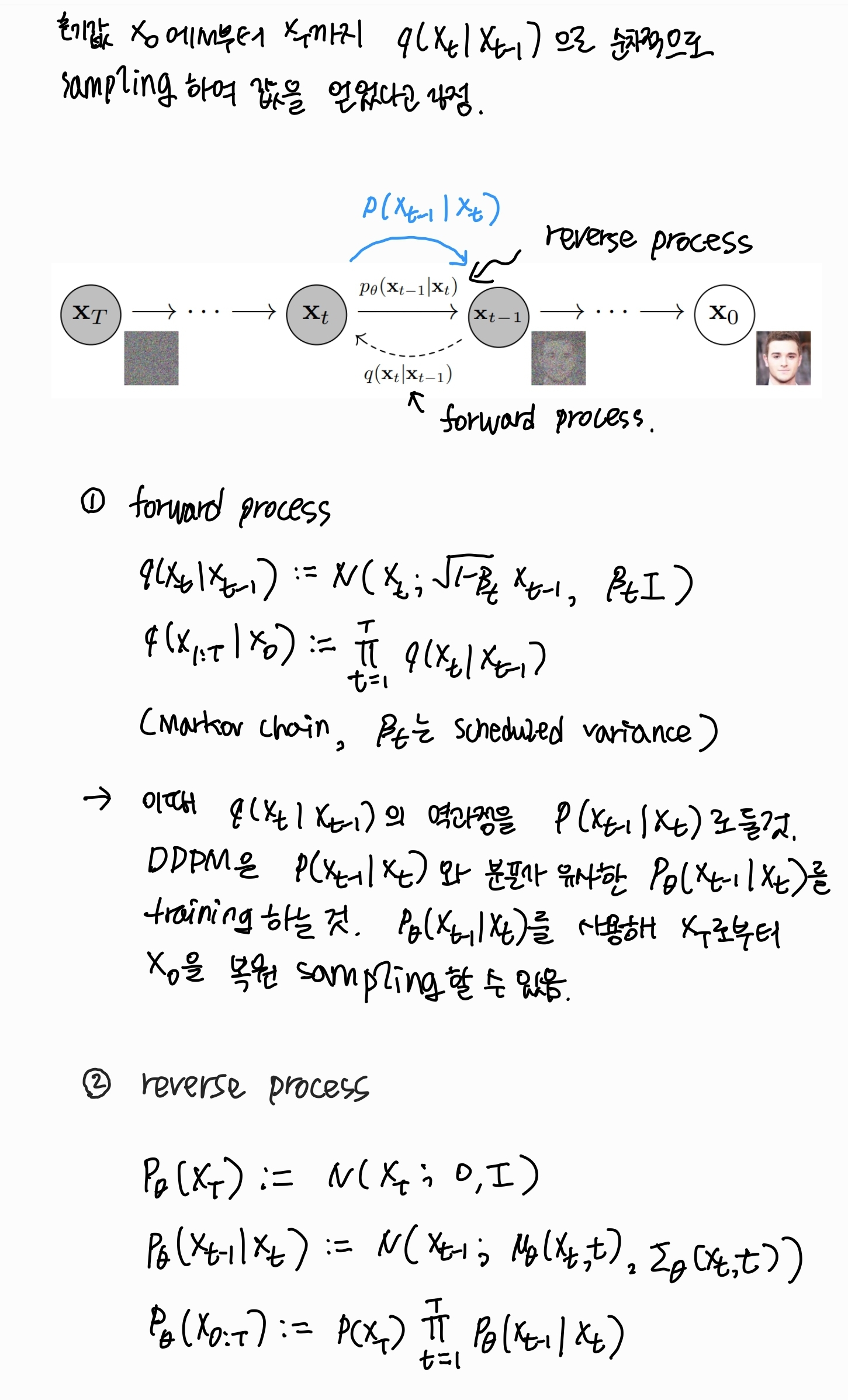
Diffusion model은 물질의 확산에 기반한 diffusion process의 inverse process를 학습하는 과정을 통해 데이터를 생성하는 generative model이다.
Diffusion model의 process는 크게 2개로 나뉘는데, 첫 번째는 diffusion mechanism을 통해 각 time step마다 데이터에 infinitesimal한 noise를 가해 결국에는 데이터와 independent한 noise를 만드는 과정이고, 두 번째는 diffusion의 reverse process를 모델링하여 random noise로부터 noise를 제거하여 원하는 데이터를 생성해내는 과정이다.

그림에서 $q(\bold{x}t\vert \bold{x}{t-1})$은 원본 데이터인 $\bold{x}0$에 noise를 가하는 diffusion process이며, $p\theta(\bold{x}_{t-1}\vert \bold{x}_t)$는 forward diffusion process의 reverse process로써 학습의 대상이다.
각각의 process는 finite time 안에 이루어지는 discrete한 과정이며, parameterized Markov chain이라고 할 수 있다.
Idea of reverse process & forward process
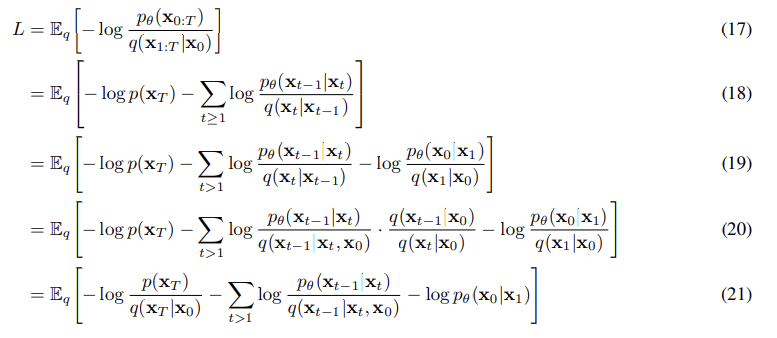
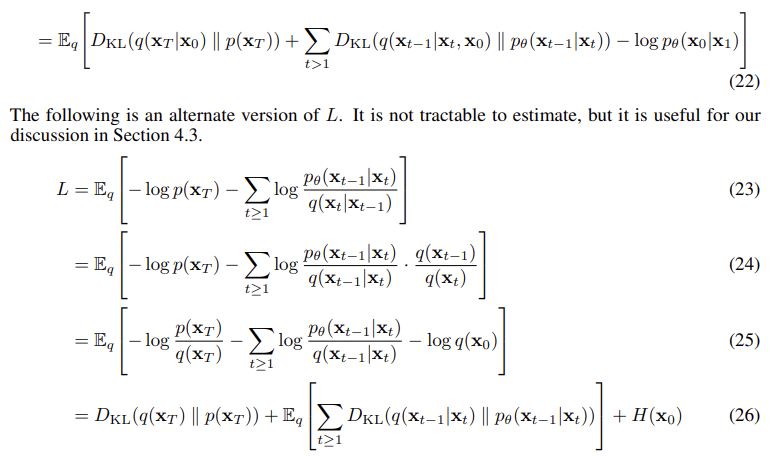
Loss derivation (Appendix A)

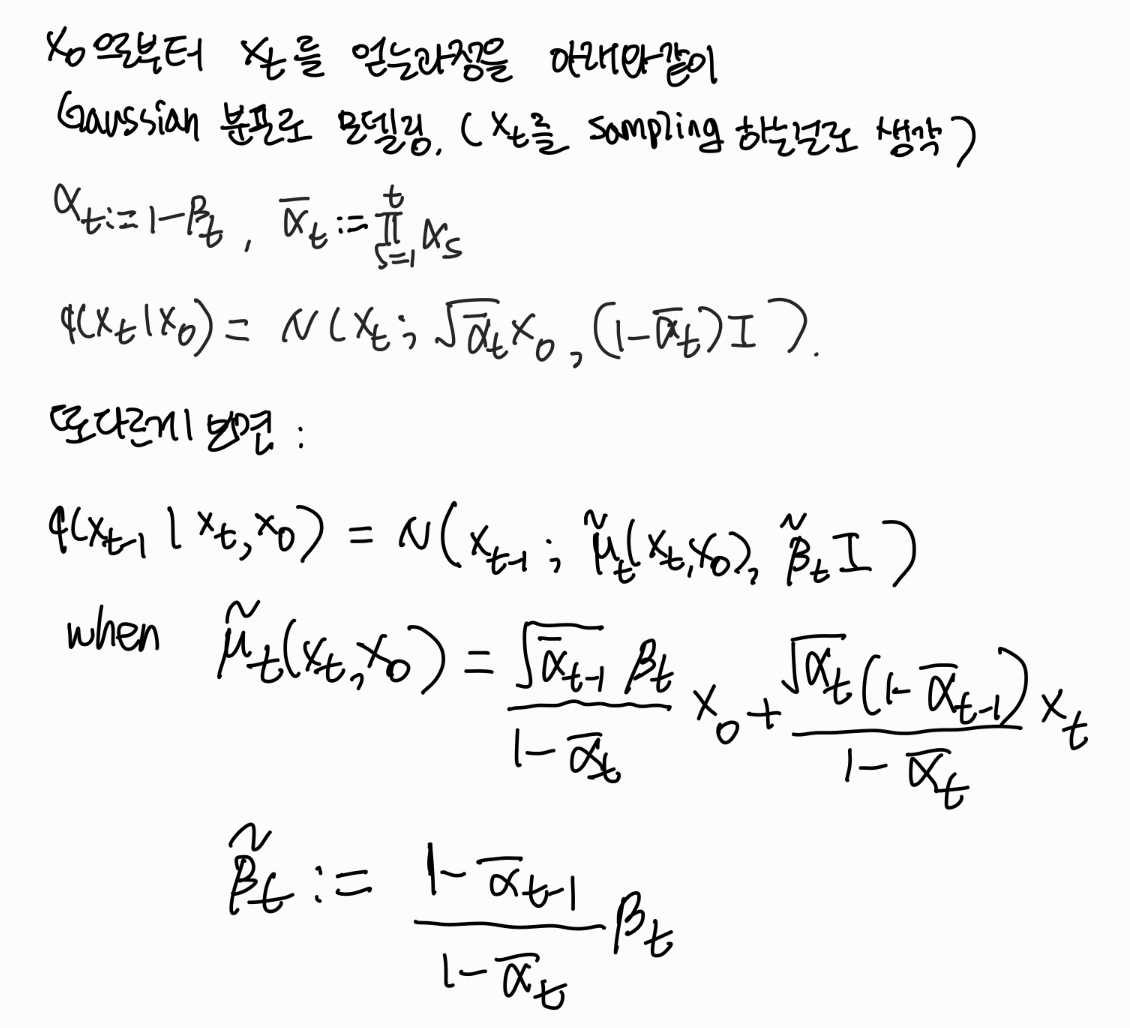
Approximation of $q(x_t\vert x_0)$
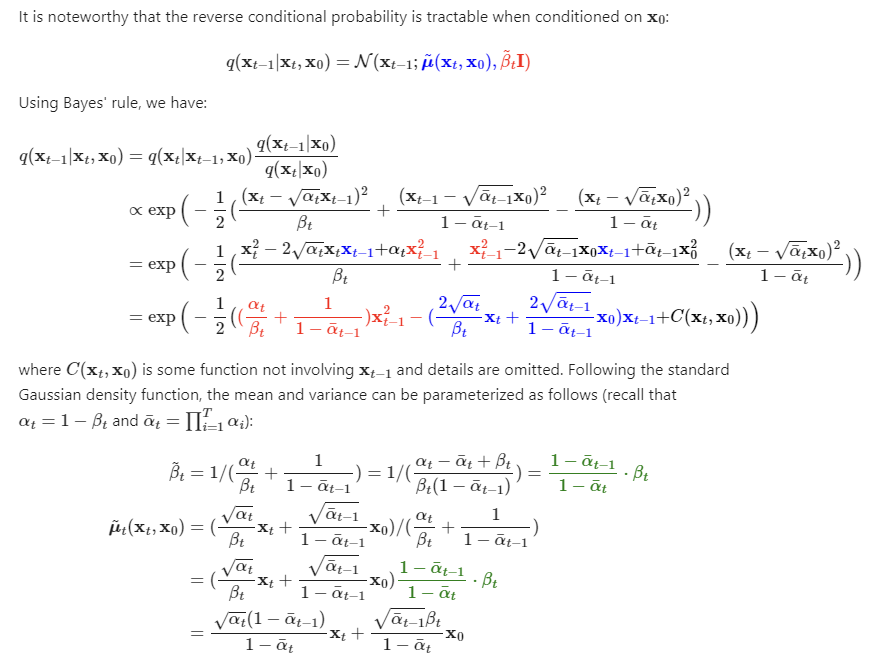
Parameterization of $p_{\theta}(x_{t-1}\vert x_t)$

$\sum_{\theta}(x_t, t)$

when

or (similar results)

$\mu_{\theta}(x_t, t)$

when parameterized

then
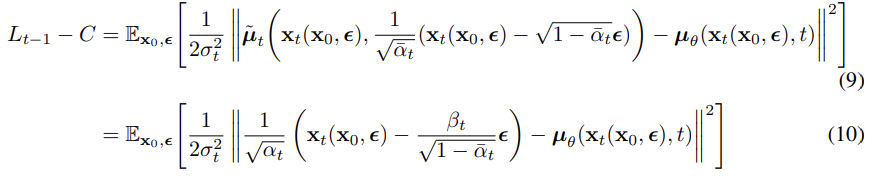
thus, $\mu_{\theta}(x_t, t)$ is parameterized to

using this, $L_{t-1}-C$ can be simplified to

메모
$\mu$를 근사하기 위하여 $\mu_{\theta}$를 학습하는 것인데, parameterization을 수정함으로써 $\epsilon$를 학습하도록 훈련할 수 있다는 것.
- model object가 $q(x_{t-1}\vert x_t, x_0)$와 $p_{\theta}(x_{t-1}\vert x_t)$의 분포를 유사하게 하는 것인데, 이는 곧 $\mu_{\theta}$와 $\tilde{\mu}$의 MSE를 최소화하는 것. 이때 $\tilde{\mu}$는 $x_0, x_t$에 대한 함수임.
- 여기에서 새로운 parameter $\epsilon$을 등장시킴. 앞서서 $x_t$를 $x_0$으로부터 sampling한 것으로 볼 수 있다고 했는데, 이에 reparameterization trick을 적용했을 때, 표준정규분포로부터 sampling한 noise의 값이 $\epsilon$.
- $\epsilon_{\theta}$와 $\epsilon$ 사이의 MSE를 최소화하도록 loss를 simplify할 수 있음
To sample $x_{t-1}$~$p_{\theta}(x_{t-1}\vert x_t)$
compute

→ reparameterization trick, z는 N(0, I)